top of page
CARRY GRID
A 2026 Melbourne Design Week carry-themed exhibition piece.
Carry Grid reframes carry as infrastructure rather than an object, placing ALPAKA’s material and hardware ecosystem at the core of how the system performs, adapts, and grows.

Research & Discovery
Understand the problem and the target audience. How does the user want to use the product. Analyse competitor benchmarks and trend insights.
My research explores how people organise and interact with everyday carry, and how modular systems can support flexible storage and display. I analysed existing modular structures and storage systems to understand different connection methods and layouts, while also considering trends in modularity and material-driven design to inform the direction of Carry Grid.

Define Requirements
Set goals, objectives, and deliverables. Gather constraints (eg. budget, time, technology)
I defined the project requirements around developing a modular structural system that balances refinement with practical fabrication. This included selecting realistic manufacturing approaches for the connector nodes, as well as appropriate materials and finishes, and a mechanical connection that allows for reconfiguration without relying on proprietary systems.
Tubes: Bead blasted Aluminum (16-20mm OD)
Nodes: 6-way bead blasted Aluminum. Manufactured through CNC billet machining or casting and machining. Machined or taped node threads for fasteners.
Texile Panels: ALPAKA fabrics tensioned or attached using modular strap connectors.
Stabilisation: Webbing or tension straps at the rear to improve structural stability.
Ideation
Brainstorm ideas and concepts. Sketch or wireframe potential solutions.


AI render
Concept Development
Choose the best ideas to develop further. Refine the concept with feedback from stakeholders.


AI render
Design
Create high-fidelity designs. Develop high-quality prototypes or mockups with high standards. Implement specific materials and finishes. The original vision must remain the same from concept to production


Still to design:
Cap ends
Feet (modular to include wheels)
Hook
ModPanel integration
Structural bracing
Webbing brace
Material shelves


Cap ends form inspo.
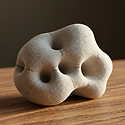
Cap ends form generation. Randomised vetices script in Blender so each node cap has a unique form - made possible through FDM 3D printing and hand finishing.

ALPAKA SKU integration. Due to the support from ALPAKA - the MODPANEL Max was given to integrate into the unit.

Worked closely with local manufacturer to CNC a slot out of the extruded tube length.
Review & Feedback
Validate the final form by testing every feature and use case. Present the design for feedback from stakeholders. Iterate and adjust based on input.


3D printed test.
First node prototype from SunPe (China manufacture).
Testing tensioned fabric shelving concept.
Finalisation
Finalise design assets and documentation. Prepare for implementation or production,
Testing & Validation
Test design with users or in real-world scenarios. Collect feedback for improvements.


bottom of page